



The short answer
“Clinically studied” is not a regulated term. It can mean a two-year, placebo-controlled trial on the exact substance in the bottle. It can also mean a one-week, uncontrolled study on a different form of the ingredient, in a different population, at a dose ten times higher, funded by the company selling it. Both earn the same two words on the label.
The gap between what a trial tested and what a product contains is the single most exploitable ambiguity in supplement marketing. Closing it takes seven questions, and this article walks you through each one with worked examples built on published trials: what each study tested, and what a label can imply about it anyway.
None of this requires a statistics degree. It requires knowing what to look for, and being willing to spend ninety seconds checking.
Why “clinically studied” is close to meaningless
The phrase has no legal definition. The FDA does not pre-approve structure-function claims, which are the category most “clinically studied” language falls into.[1] The FTC requires “competent and reliable scientific evidence” for advertising claims, and it evaluates what a claim implies, not only what it says. A company can cite a genuine study and still mislead you when the study does not support the benefit implied for the product being sold, because a trial on one ingredient or formulation does not automatically validate a different finished product.[2] Enforcement exists, and it usually arrives after the ad has run.
The industry knows this. A private-label manufacturer’s guide to “clinically studied ingredients” explains that “a clinically studied ingredient does not automatically make a finished supplement clinically validated”, advice aimed at brands deciding which science to borrow for their labels.[3] The same gap that manufacturers exploit is the one you can learn to check.
The seven questions
1. Is this the same form?
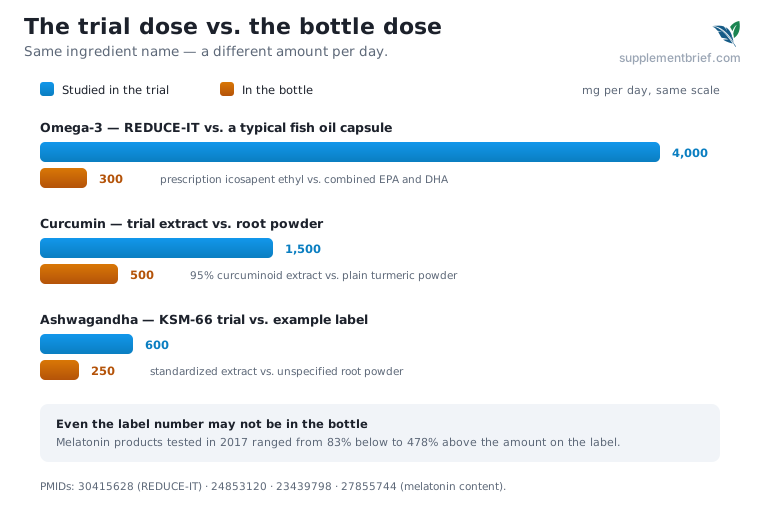
Magnesium oxide absorbs at roughly 4 percent, far less than magnesium chloride, lactate, and aspartate in the same study.[4] A trial on one form is not a trial on another. Consider a curcumin label citing trials that used standardized 95-percent curcuminoid extracts at 1,500 mg per day[5] while the bottle contains plain turmeric root powder at 500 mg. Same plant, different substance.
The teaching version: a trial on the Ferrari version of the nutrient does not certify the rental-car version in the bottle.
2. Is this the same dose?
REDUCE-IT, the trial behind many “omega-3 for heart health” claims, used 4 grams per day of prescription icosapent ethyl, a pure EPA ester sold only by prescription.[6] For scale, a typical 1,000-mg fish oil capsule provides about 300 mg of combined EPA and DHA, and amounts vary widely between products.[25] The trial was real and published in the New England Journal of Medicine. A label citing it from a 300-mg capsule is borrowing a reputation, not a result, and the gap is not only milligrams: a mixed EPA and DHA oil is a different substance in a different chemical form.
Picture an ashwagandha label citing the KSM-66 trial at 600 mg per day while the bottle holds unspecified root powder at 250 mg. The trial exists, and the match does not.[7]
A 2017 chemical analysis of melatonin products found actual content ranging from 83 percent below to 478 percent above the label claim, a spread so wide that even if the cited trial used the “right” dose, the bottle may not contain it.[8]
3. Was it the same population?
The KSM-66 ashwagandha trial enrolled 64 adults with a clinical history of chronic stress, not healthy people looking for a wellness boost.[7] The botanicals tested for hot flashes enrolled women aged 45 to 60 having 8 or more episodes per day, not a 35-year-old with occasional discomfort.[9] If you do not resemble the people studied, the citation is not about you.
4. Was the outcome what is promised?
This is the surrogate endpoint trap, and it is everywhere. Fish oil reliably lowers triglycerides by 20 to 30 percent, a blood test improvement. But VITAL, the largest omega-3 trial ever run, tested 25,871 people for 5.3 years and found no significant reduction in the primary composite cardiovascular endpoint from 1 gram per day of standard fish oil (HR 0.92, P=0.24), Total heart attacks, a secondary endpoint, were significantly reduced (HR 0.72, 95% CI 0.59 to 0.90), a finding the authors characterized as hypothesis-generating among many secondary comparisons rather than as proof of protection.[10] “Lowers triglycerides” and “prevents heart attacks” are different claims. Supplements are advertised on the first and bought for the second.
The same pattern: vitamin D blood levels move, but 81 randomized trials in 53,537 people found no clinically meaningful reduction in fractures.[11] Antioxidant supplements improve oxidative-stress markers on lab panels, but in 68 low-bias trials covering 232,606 participants, beta-carotene, vitamin A, and vitamin E were each associated with a small increase in mortality.[12] Blood markers are stethoscopes, not symptoms.
5. How big was the effect?
Glucosamine for joint pain: a network meta-analysis of 10 trials in 3,803 patients found it beat placebo by 0.4 centimeters on a 10-centimeter pain scale, below the 0.9-centimeter threshold that patients themselves call meaningful.[13] Statistically significant, clinically invisible.
Melatonin for sleep onset: a meta-analysis of 17 trials found it helps you fall asleep 4 minutes faster.[14] Multivitamin cognition coverage announced three years of brain aging prevented. The measurements: COSMOS-Web reported a memory improvement equivalent to 3.1 years of age-related change,[26] and the companion COSMOS-Mind trial put the global-cognition benefit at 0.07 of one standard deviation (P=0.007), statistically significant and clinically invisible at the same time.[21] Vitamin C tells the same story from the cold aisle: 29 trials, 11,306 people, and the average cold shortened by about half a day.[22] Two sitcom credit sequences. Green tea extract for weight loss: a Cochrane meta-analysis of trials conducted outside Japan found an average effect of minus 0.04 kilograms, about 40 grams. Japanese trials showed larger effects but could not be pooled.[15]
And the placebo problem compounds this: in osteoarthritis trials, the placebo arm improves at half the strength of an active drug, because pain is subjective and hope is therapeutic.[16] In hot-flash trials, the placebo group improved 60 percent.[9] The effect is largest for subjective outcomes like pain, mood, and self-reported symptoms, and smallest for objective measures like blood pressure or bone density.[24] When marketing says “55 percent improved,” the first question is what the sugar pill did.
6. Who paid for it?
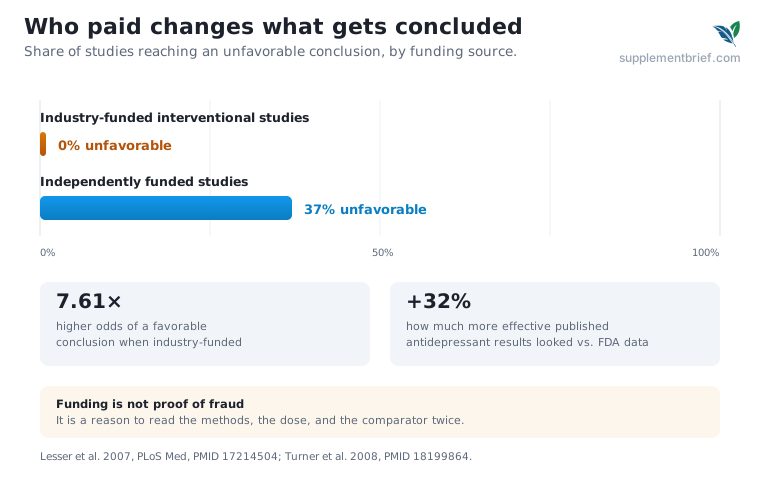
The classic study pooled 206 nutrition articles, 111 of them declaring a sponsor. The odds of a favorable conclusion were 7.61 times higher for articles funded entirely by industry than for independently funded ones (95% CI 1.27 to 45.73, an interval wide enough that the exact size of the effect is uncertain). The sharpest split was interventional: 0 percent of industry-funded interventional studies reached an unfavorable conclusion, versus 37 percent of independently funded ones.[17] A 2026 meta-research review found industry-linked meat studies had 16-fold higher odds of conclusions favorable to meat.[18]
Funding does not mean fraud. It means the question, the dose, the comparator, and the press release were designed by someone with a financial stake. The publication-bias multiplier compounds this: published trial results made antidepressants look 32 percent more effective than the FDA’s own analysis of the complete data set.[23] Read the methods section twice when the sponsor owns the ingredient.
7. Has anyone replicated it?
Saw palmetto had decades of supportive European trials. Then NIH ran CAMUS: 72 weeks, up to three times the standard dose, 369 men. Symptoms fell 2.20 points on saw palmetto versus 2.99 on placebo, the herb performed worse than the sugar pill.[19]
Akkermansia muciniphila is a supplement category built on a proof-of-concept trial with 32 completers, patent-holding authors who founded the company selling it, and a weight-loss endpoint that missed significance.[20] One good trial is a hypothesis. Check whether study number two came from someone other than the seller.
The fast version: a working checklist
When a label says “clinically studied” or “clinically proven”:
- Find the citation. If no study is named, the claim is unfalsifiable and you are done.
- Look up the PMID on PubMed. If the citation does not resolve to a real paper, the claim cannot be verified.
- Check the form: is the studied substance the same chemical as what is in the bottle?
- Check the dose: does the label amount match the trial amount per day? Our dose registry lists the studied amounts by ingredient: a comparison reference, not a dosing standard.
- Check the population: do you resemble the people who were studied?
- Check the outcome: was the endpoint a clinical outcome or a blood marker?
- Check the effect size: would you notice the difference the trial found?
- Check the funding: who paid, and do they sell the ingredient?
- Check for replication: has an independent team found the same thing?
Steps 1 and 2 take thirty seconds. Steps 3 through 9 take another minute with the abstract open. The seven questions in this article map to steps 3 through 9, and steps 1 and 2 are the prerequisite. The more of these checks return no, the less the citation supports the claim. A mismatch in form, dose, or outcome can be decisive on its own. Mismatches in population, funding, or replication decide how far a real result carries to your bottle.
What this means for the supplement buyer
None of this means supplements are useless or that all research is bought. The strongest case for a supplement is also the least marketed one: correcting a laboratory-confirmed deficiency, iron, vitamin B12, a measured-low vitamin D level, where the bottle is treatment and works regardless of what the label claims. Beyond that, the distance between a real trial and a label claim is where marketing lives, and you now have the tools to measure it. The products that survive all seven questions are the ones worth taking seriously. The ones that fail the first two checks, finding the citation and verifying it exists, are claims you cannot evaluate at all.
What a passed check looks like
Give the ashwagandha trial from the earlier questions a fair hearing. A product containing 600 mg per day of the actual standardized KSM-66 root extract, citing that trial, passes the first four questions at once: same extract, same dose, same population of adults with chronic stress, a measured stress-score outcome.[7] The citation is real, and this time it points at the bottle being sold. Questions five through seven are where the reading continues: check the effect size in the paper itself, check who funded the work, and look for independent replication before treating the result as settled. That is the whole method in one example. The match decides whether the citation is worth reading, and the funding and replication checks decide how far you trust it.
FAQ
Where do I find the study behind a "clinically studied" claim?
Look for a citation on the label or the brand's website. If they name a specific trial, search the title on PubMed (pubmed.ncbi.nlm.nih.gov). If they only say "clinically studied" without naming the study, there is nothing to check, which is itself an answer. If they cite a branded ingredient (KSM-66, Crominex 3+, etc.), search for that ingredient name plus "trial" or "PMID" to find the original study.
Does industry funding automatically mean the study is wrong?
No. Industry-funded studies can be well-designed and honestly reported. The finding is that their odds of reaching conclusions favorable to the sponsor are several times higher, which makes them a reason to check the methods carefully, not to dismiss the results. The strongest pattern: when the sponsor owns the ingredient, pay extra attention to the dose used, the comparator chosen, and whether the primary endpoint was changed after the study started.
What is the difference between "clinically studied" and "clinically proven"?
Legally, almost nothing. "Clinically proven" carries slightly more FTC risk because it implies a stronger standard, but the FTC's substantiation requirement is flexible. Both phrases can legally cite a single small study on a different form of the ingredient. The seven questions in this article apply equally to both.
Can I use this checklist for prescription drugs too?
The questions are the same, but the baseline is different. Prescription drugs require FDA pre-market approval, typically supported by at least two adequate, well-controlled trials, though the agency can accept one strong trial plus confirming evidence in certain cases. Supplements require none. So while the seven-question checklist sharpens your reading of any trial, for supplements it is doing much heavier lifting: you are the last quality control in the pipeline.
Free weekly brief
Want the supplement evidence brief once a week?
Get one hype-free email on evidence changes, safety notes, interaction-base updates, comparison criteria, and tools or dose-registry updates before you buy. No daily sequences, no paid rankings.
Get the free checklistFree. One email a week. Unsubscribe anytime.
How this article was researched
Evidence scan: PubMed, FTC enforcement actions, and published meta-research on funding bias and publication bias, October 2026. Every PMID was verified against live PubMed records. Effect-size examples were chosen for teaching clarity: each represents a well-known claim where the absolute benefit is smaller than the marketing implies.
Three common industry practices were documented from primary sources but not individually named: citation of branded-ingredient trials for different ingredients, citation of foreign-language or retracted papers, and the “proprietary blend” loophole where total amounts are listed but individual doses are hidden. The blend loophole is covered in our label-reading guide.
Research date: October 21, 2026. Updates planned if the FTC’s 2026 health-claim substantiation guidance meaningfully changes the enforcement landscape.
Sources
-
U.S. Food and Drug Administration. Questions and Answers on Dietary Supplements. Updated Aug 27, 2026. fda.gov. Accessed October 20, 2026.
-
Federal Trade Commission. Health Products Compliance Guidance. ftc.gov. Accessed October 20, 2026.
-
Intermountain Nutrition. The Evidence Economy: Clinically Studied Ingredients. intermountainnutrition.com. Accessed October 20, 2026.
-
Firoz M, Graber M. Bioavailability of US commercial magnesium preparations. Magnesium Research. 2001;14(4):257-62. PMID 11794633.
-
Panahi Y, Rahimnia AR, Sharafi M, et al. Curcuminoid treatment for knee osteoarthritis: a randomized double-blind placebo-controlled trial. Phytotherapy Research. 2014;28(11):1625-1631. doi:10.1002/ptr.5174. PMID 24853120.
-
Bhatt DL, Steg PG, Miller M, et al. Cardiovascular risk reduction with icosapent ethyl for hypertriglyceridemia (REDUCE-IT). New England Journal of Medicine. 2019;380(1):11-22. doi:10.1056/NEJMoa1812792. PMID 30415628.
-
Chandrasekhar K, Kapoor J, Anishetty S. A prospective, randomized double-blind study of Ashwagandha root extract (KSM-66) in stress and anxiety. Indian Journal of Psychological Medicine. 2012;34(3):255-62. PMID 23439798.
-
Erland LAE, Saxena PK. Melatonin natural health products and supplements available to aid sleep contain adulterants and contaminants. Journal of Clinical Sleep Medicine. 2017;13(2):275-281. PMID 27855744.
-
Tice JA, Ettinger B, Ensrud K, et al. Phytoestrogen supplements for the treatment of hot flashes (ICE study). JAMA. 2003;290(2):207-214. doi:10.1001/jama.290.2.207. PMID 12851275.
-
Manson JE, Cook NR, Lee IM, et al. Marine n-3 fatty acids and prevention of cardiovascular disease and cancer (VITAL). New England Journal of Medicine. 2019;380(1):23-32. doi:10.1056/NEJMoa1811403. PMID 30415637.
-
Bolland MJ, Grey A, Avenell A, et al. Vitamin D supplementation and prevention of fractures: meta-analysis of 81 randomized trials. Lancet Diabetes and Endocrinology. 2018;6(11):847-858. PMID 30293909.
-
Bjelakovic G, Nikolova D, Gluud LL, et al. Mortality in randomized trials of antioxidant supplements for primary and secondary prevention. JAMA. 2007;297(8):842-857. doi:10.1001/jama.297.8.842. PMID 17327526.
-
Wandel S, Jüni P, Tendal B, et al. Effects of glucosamine, chondroitin, or placebo in patients with osteoarthritis of hip or knee (network meta-analysis). BMJ. 2010;341:c4675. doi:10.1136/bmj.c4675. PMID 20847017.
-
Brzezinski A, Vangel MG, Wurtman RJ, et al. Effects of exogenous melatonin on sleep: a meta-analysis. Sleep Medicine Reviews. 2005;9(1):41-50. doi:10.1016/j.smrv.2004.06.004. PMID 15649737.
-
Jurgens TM, Whelan AM, Killian L, et al. Green tea for weight loss and weight maintenance in overweight or obese adults (Cochrane review). Cochrane Database of Systematic Reviews. 2012;12:CD008650. doi:10.1002/14651858.CD008650.pub2. PMID 23235664.
-
Zhang W, Robertson J, Jones AC, et al. The placebo effect and its determinants in osteoarthritis (meta-analysis). Annals of the Rheumatic Diseases. 2008;67(12):1716-1723. PMID 18541604.
-
Lesser LI, Ebbeling CB, Goozner M, et al. Relationship between funding source and conclusion among nutrition-related scientific articles. PLoS Medicine. 2007;4(1):e5. doi:10.1371/journal.pmed.0040005. PMID 17214504.
-
Teimouri N, et al. Meta-research review of industry ties in meat-and-health studies. Obesity Reviews. 2026. PMID 42070899.
-
Barry MJ, Meleth S, Lee JY, et al. Effect of increasing doses of saw palmetto extract on lower urinary tract symptoms (CAMUS trial). JAMA. 2011;306(12):1344-1351. PMID 21954478.
-
Depommier C, Everard A, Druart C, et al. Supplementation with Akkermansia muciniphila in overweight and obese human volunteers (proof-of-concept trial). Nature Medicine. 2019;25(7):1096-1103. doi:10.1038/s41591-019-0495-2. PMID 31263284.
-
Baker LD, Manson JE, Rapp SR, et al. Effects of cocoa extract and a multivitamin on cognitive function (COSMOS-Mind). Alzheimer's and Dementia. 2023;19(4):1308-1319. doi:10.1002/alz.12767. PMID 36102337.
-
Hemilä H, Chalker E. Vitamin C for preventing and treating the common cold (Cochrane review). Cochrane Database of Systematic Reviews. 2013;(1):CD000980. doi:10.1002/14651858.CD000980.pub4. PMID 23440782.
-
Turner EH, Matthews AM, Linardatos E, et al. Selective publication of antidepressant trials and its influence on apparent efficacy. New England Journal of Medicine. 2008;358(3):252-260. doi:10.1056/NEJMsa065779. PMID 18199864.
-
Hróbjartsson A, Gøtzsche PC. Is the placebo powerless? An analysis of clinical trials comparing placebo with no treatment. New England Journal of Medicine. 2001;344(21):1594-1602. doi:10.1056/NEJM200105243442106. PMID 11372012.
-
National Institutes of Health, Office of Dietary Supplements. Omega-3 Fatty Acids: Health Professional Fact Sheet. ods.od.nih.gov. Accessed October 21, 2026.
-
Yeung LK, Alschuler DM, Wall M, et al. Multivitamin supplementation improves memory in older adults: a randomized clinical trial (COSMOS-Web). American Journal of Clinical Nutrition. 2023;118(1):273-282. doi:10.1016/j.ajcnut.2023.05.011. PMID 37244291.