



The short answer
Most dietary supplements never undergo FDA premarket approval for safety or effectiveness. There is no universal product-registration or approval process for every supplement sold in the United States, and no complete list of what exists on the market. The manufacturer sets the formula and dose, writes the claim, and bears legal responsibility for safety and substantiation. Specific premarket requirements do exist for certain new dietary ingredients and certain label claims. For most finished products, the FDA’s oversight happens after marketing, and the agency can take action when it identifies violations or safety concerns.[2]
DSHEA established the basic framework that still governs the US dietary-supplement market. Later laws and rules added requirements, including serious adverse-event reporting and current good manufacturing practices, but the system still does not require universal premarket approval of finished supplements.[2][26] This guide explains what the law says, what each type of label claim means, what enforcement looks like in practice, and what may be changing.
The law: DSHEA 1994
Before DSHEA, the regulation of dietary supplements was fragmented, with different rules and court decisions governing vitamins, minerals, botanicals, and other ingredients. In 1993, the FDA proposed treating some amino acids as unapproved food additives and some botanicals as drugs, and considered limits on vitamin and mineral potency. The proposal drew strong opposition from industry and consumers. Congress responded, and on October 25, 1994, President Clinton signed the Dietary Supplement Health and Education Act.[1][17]
DSHEA did four things that still define the landscape:[17]
- Defined a dietary supplement as a product, other than tobacco, intended to supplement the diet, intended for ingestion, and labeled as a dietary supplement rather than a conventional food or the sole item of a meal or diet, containing one or more dietary ingredients. These include vitamins, minerals, herbs or other botanicals, amino acids, dietary substances, and concentrates, metabolites, constituents, extracts, or combinations of these ingredients.
- Classified supplements as a subcategory of food, not drugs. No general premarket approval of finished products is required.
- Established specific rules for structure/function claims, the “supports immune health” language, requiring substantiation, a mandatory disclaimer, and notification to the FDA within 30 days after first marketing.
- Established the NDI (New Dietary Ingredient) notification system for dietary ingredients not marketed in the United States as ingredients in dietary supplements before October 15, 1994.
What DSHEA did not do is equally important. It did not establish a universal premarket safety-testing requirement for finished dietary supplements. It did not establish a general premarket approval process for finished dietary supplements. It did not create a product registry. And it set no universal ceiling on the dose in a serving, though the FDA can still act against an unsafe ingredient under other rules.[2]
What the FDA actually does
For most finished supplements, the FDA’s role is primarily post-market enforcement, alongside the specific premarket requirements for new ingredients and certain claims. The agency can inspect manufacturing facilities, issue warning letters, request voluntary recalls, seize products, and pursue criminal prosecution through the Department of Justice. These tools are triggered when the FDA identifies a violation, whether through a routine inspection, a label review, an adverse-event report, or a laboratory finding, not only after consumers are harmed.
Inspections
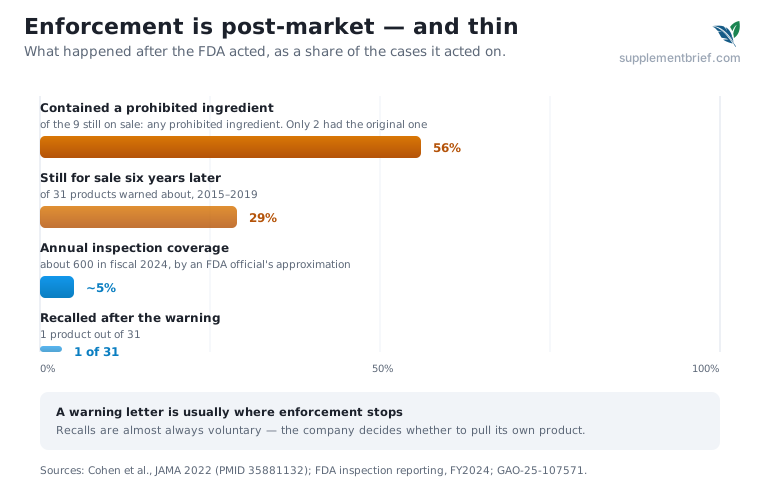
The FDA inspects supplement manufacturing facilities under the cGMP rule (21 CFR Part 111, effective August 24, 2007).[26] In fiscal year 2024, the agency conducted about 600 dietary-supplement cGMP inspections, 510 domestic and 90 foreign, figures reported by SupplySide from FDA data obtained through a Freedom of Information Act request.[3] An FDA official has described annual inspection coverage as roughly 5 percent of known facilities, an approximation rather than a count of unique facilities inspected each year.[3] The agency prioritizes higher-risk facilities, so inspection frequency varies.
Warning letters
When the FDA identifies what it considers significant violations, a warning letter is one common form of formal notice. Between 2015 and 2019, the agency issued warning letters targeting 31 supplement products containing prohibited ingredients. A follow-up study found that only 1 of the 31 products was recalled. Nine, 29 percent, remained available for purchase a mean of six years after the warning letters, and five of those nine, 56 percent, contained at least one FDA-prohibited ingredient. Only two still contained the specific ingredient that had prompted the original warning letter.[4]
Recalls
Supplement recalls are usually initiated voluntarily, sometimes after the FDA raises a concern or requests action.[20] Under the Food Safety Modernization Act, the FDA can also order a mandatory recall when it determines a product is adulterated or misbranded and that there is a reasonable probability it will cause serious adverse health consequences or death. The law generally gives the responsible firm a chance to recall it voluntarily first, unless doing so would be ineffective.[5] The distinction is between the authority that exists on paper and how often it is used in practice.
Criminal cases
Between 2007 and 2016, the FDA flagged 776 supplement products containing undeclared pharmaceutical drugs, from 146 companies, and 97.6 percent did not list the drug on the label.[15] Prosecutions are rare, but they happen. USPLabs, maker of the pre-workout Jack3d, saw its former CEO Jacobo Geissler sentenced in 2020 to 60 months in prison and a $250,000 fine for a scheme importing dietary supplement ingredients from China, including the synthetic stimulant DMAA, using false certificates of analysis and false labeling. DMAA-containing supplements have been implicated in reports involving fatal cardiovascular events, although such reports do not establish DMAA as the sole cause.[29] Two companies forfeited a combined $10.7 million.[6] In 2025, Hi-Tech Pharmaceuticals’ CEO Jared Wheat and the company were convicted of wire fraud and money laundering in a scheme that fabricated GMP audit certificates, doctored an independent audit report, and used fraudulent FDA Certificates of Free Sale, netting $4.7 million.[7]
FTC and advertising claims
The FDA handles the label. Advertising has a second regulator: in June 2026 the FTC filed a contempt motion alleging that Amare Global and several individuals kept making unsubstantiated claims that their products could treat conditions such as depression, anxiety, and ADHD in children, in violation of a prior FTC order. The matter remains pending.[16]
The claims taxonomy: what each label language means
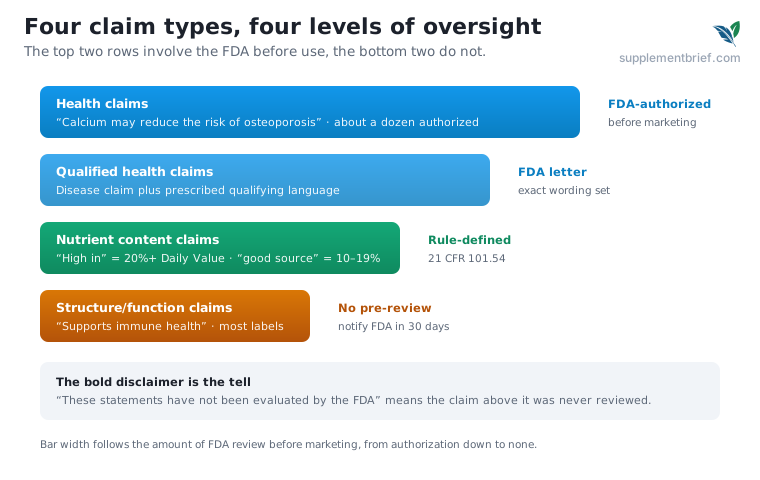
FDA rules identify three main categories of dietary-supplement label claims. On the shelf you meet four kinds of wording, because qualified health claims run through their own letter-based pathway as a variant of health claims. Each carries a different amount of FDA review behind it. Rarer statutory types, like claims about classical nutrient-deficiency diseases and general well-being, follow requirements similar to structure/function claims.[27] For decoding the rest of the panel, our label-reading guide walks the other parts of the bottle.
Health claims (“calcium may reduce the risk of osteoporosis”)
These describe a relationship between a substance and a disease. The traditional route requires FDA authorization by regulation after a finding of “significant scientific agreement.”[27] Only about a dozen health claims have been authorized through this traditional route. Other pathways exist for certain claims, including the qualified health claims below. These are the most rigorous and the least common on supplements.
Qualified health claims (“scientific evidence suggests but does not prove…”)
These describe a substance-disease relationship with qualifying language. They emerged from the 1999 decision in Pearson v. Shalala, which helped establish the pathway by requiring the FDA to consider whether qualifying language could address the risk of misleading consumers. For petitions supported by credible scientific evidence, the FDA may issue a Letter of Enforcement Discretion specifying claim language and the conditions under which it does not intend to object to its use.[28] There are more of these than authorized health claims, but still relatively few.
Structure/function claims (“supports immune health,” “promotes joint comfort”)
These are what most supplement labels carry. They describe the role of a nutrient or dietary ingredient in affecting the structure or function of the body, but they cannot claim to diagnose, mitigate, treat, cure, or prevent a disease, explicitly or by implication. They require:
- The manufacturer’s substantiation (which the FDA does not routinely review before marketing)
- Notification to the FDA within 30 days after first marketing
- The mandatory disclaimer in bold type: “These statements have not been evaluated by the Food and Drug Administration. This product is not intended to diagnose, treat, cure, or prevent any disease.”[8]
That disclaimer does honest work: in bold, it tells you the FDA has not evaluated the claim as a premarket determination of efficacy. It is not an endorsement, and it does not mean the FDA evaluated and rejected it. Whether the citation behind a claim actually matches the bottle is a separate check, taught in what “clinically studied” means.
Nutrient content claims (“high in calcium,” “good source of fiber”)
These describe the amount of a nutrient in a product relative to a reference value. They follow the same rules as nutrient content claims on conventional foods (21 CFR 101.54). “High in” means 20 percent or more of the Daily Value per reference amount customarily consumed. “Good source” means 10 to 19 percent. These claims are relatively straightforward: the thresholds are numeric and printed in the regulation.
The NDI system and the October 2026 guidance
The New Dietary Ingredient notification is the closest thing supplements have to a pre-market safety check. If an ingredient was not marketed in the United States as a dietary ingredient before October 15, 1994, and was not present in the food supply as an article used for food in a chemically unaltered form, the manufacturer or distributor must notify the FDA at least 75 days before the product enters interstate commerce, with evidence that it is “reasonably expected to be safe.”[9]
The notification is not an approval. The absence of an FDA objection does not establish that the ingredient is safe or that the product complies with all applicable requirements. The manufacturer’s legal obligations remain. And the notification must lay out the basis for that safety conclusion, citing the history of use or other safety evidence, but it is not a drug-style dossier that the FDA approves.[9]
On October 19, 2026, the FDA issued its final guidance on Sections VI.A through VI.C of the NDI framework, covering identity information and the basis for concluding an ingredient is safe.[10] This is a notable step in the FDA’s gradual finalization of its revised NDI guidance, though it finalizes only a portion of the full framework. Other sections remain open.
What may be changing
The Dietary Supplement Listing Act of 2026
Senator Durbin introduced S.3677 in January 2026, and Representative Dexter introduced a companion bill (H.R.8370) in April.[11][19] Neither has passed. If enacted, the law would require every supplement product to be listed in a publicly searchable FDA database, with the listing number printed on the label. The FDA has stated it “is not able to keep a complete list of all dietary supplements sold in the United States”.[2] The Listing Act is designed to close that gap.[11]
State age-verification laws
New York became the first state to ban the sale of weight-loss and muscle-building supplements to minors in April 2024. The industry challenged the law to the Supreme Court, which denied review on October 5, 2026, leaving the law in effect while the underlying litigation continues in the lower courts. A denial of review is not a ruling on the law itself.[12][24] California followed with AB 2030, signed September 28, 2026, and scheduled to take effect January 1, 2027.[18][23]
The ACP position paper
In September 2026, the American College of Physicians published a position paper in Annals of Internal Medicine calling for modernization of the regulatory framework, citing pre-market review, mandatory product listing, and improved adverse-event reporting as priorities.[13] It is a major clinical-society position paper calling for regulatory reform.
How the US compares to other countries
| Country | Pre-market requirement | What the consumer sees |
|---|---|---|
| United States | No general premarket approval of finished products, though NDI and claim requirements apply | Structure/function claims with disclaimer, no universal product listing |
| European Union | National rules vary: member states may require pre-sale notification | EU-wide rules govern claims and contaminant limits |
| Canada | Product licence required before sale | 8-digit Natural Product Number (NPN) on the label, public database |
| Australia | Listed (low-risk) or registered (higher-risk) | AUST L or AUST R number on the label, ingredients restricted |
Canada requires a product licence before sale, and Australia treats complementary medicines as medicines, with listed and registered pathways. In the EU, rules on claims and contaminants are harmonized at the EU level, while pre-sale notification requirements vary by member state.[21][22][25] The US does not require universal product listing or general premarket approval of finished supplements, although specific premarket requirements apply to certain new dietary ingredients and health claims.[14]
What this means for you
The regulatory system relies primarily on oversight after products reach the market, rather than mandatory premarket review of every finished supplement. That leaves you with less regulatory assurance before purchase, even though the FDA can act when it identifies violations or safety concerns. The practical consequence: you are the last quality control. Third-party certifications (NSF, USP, Informed Sport), published certificates of analysis, and brands that voluntarily test beyond the minimum are your tools for navigating a system where the baseline is trust, not proof. Which seals to trust and why is a separate guide.
FAQ
Does the FDA approve supplements before they are sold?
No. Under DSHEA, the FDA does not generally approve finished dietary supplements for safety or effectiveness before marketing. The manufacturer is responsible for ensuring the product is safe and that claims are substantiated. Specific premarket requirements, like NDI notification for new ingredients, exist for particular cases rather than for finished products as a class. The FDA can take action after a product is on the market if it is found to be unsafe or misbranded.
What does the disclaimer on supplement labels actually mean?
The statement "These statements have not been evaluated by the Food and Drug Administration" means the claim has not undergone FDA premarket evaluation or authorization. It is not an endorsement, and it does not mean the FDA evaluated and rejected the claim, or that any third party verified it. It exists because DSHEA allows structure-function language only with this disclosure. A claim that a supplement diagnoses, mitigates, treats, cures, or prevents a disease can cause the product to be regulated as a drug. Permitted health claims follow a separate, narrowly defined pathway and generally concern the relationship between a substance and reduced disease risk.
Is Congress going to change the law?
The Dietary Supplement Listing Act of 2026 (S.3677, H.R.8370) would require product listing in an FDA database, but both bills are still in committee and neither has passed. The FDA's October 2026 final NDI guidance tightens the safety-evidence framework for new ingredients but does not create pre-market approval for finished products. State-level changes are happening faster: New York's age restriction is in effect while litigation continues, and California's AB 2030 takes effect January 1, 2027.
Are supplements regulated in other countries the same way?
No. Canada requires a product licence (NPN) before sale. Australia regulates supplements as medicines, with listed or registered status. EU countries set binding contaminant and claims rules, and some require pre-sale notification. The US relies on post-market enforcement for most products, with premarket requirements only for new ingredients and certain claims.
Free weekly brief
Want the supplement evidence brief once a week?
Get one hype-free email on evidence changes, safety notes, interaction-base updates, comparison criteria, and tools or dose-registry updates before you buy. No daily sequences, no paid rankings.
Get the free checklistFree. One email a week. Unsubscribe anytime.
How this article was researched
Evidence scan: FDA regulatory documents (DSHEA text, NDI guidance pages, cGMP rule, warning-letter database, Q&A page updated August 2026), Congressional bills (S.3677, H.R.8370), court records (CRN v. James, Second Circuit and Supreme Court dockets), DOJ prosecution releases (USPLabs, Hi-Tech Pharmaceuticals), FTC enforcement actions (Amare Global, TruHeight), and peer-reviewed analyses of enforcement effectiveness (Cohen et al., JAMA 2022). Key legal requirements were checked against primary regulatory sources where available. Every PMID was verified against the corresponding PubMed record.
Research date: October 23, 2026. Updates planned as the NDI guidance continues to be finalized in sections, as the Listing Act moves through Congress, and as additional states pass age-verification laws.
Sources
-
National Institutes of Health, Office of Dietary Supplements. Dietary Supplement Health and Education Act of 1994. ods.od.nih.gov. Accessed October 20, 2026.
-
U.S. Food and Drug Administration. Questions and Answers on Dietary Supplements. Updated Aug 27, 2026. fda.gov.
-
SupplySide Supplement Regulatory Journal. FDA Increases Annual Domestic and Foreign Dietary Supplement Inspections. supplysidesj.com. Accessed October 20, 2026.
-
Cohen PA, Avula B, Katragunta K, et al. Recalls, Availability, and Content of Dietary Supplements Following FDA Warning Letters. JAMA. 2022;328(4):393-395. PMID 35881132.
-
U.S. Food and Drug Administration. Questions and Answers Regarding Mandatory Food Recalls: Guidance for Industry. November 2018. fda.gov.
-
U.S. Department of Justice. Two Individuals and Two Companies Sentenced in Scheme to Fraudulently Sell Popular Dietary Supplements. October 2020. justice.gov.
-
U.S. Department of Justice. Two-Time Convicted Felon CEO and His Dietary Supplement Company Convicted in $4.7 Million Scheme. November 21, 2025. justice.gov.
-
U.S. Food and Drug Administration. 21 CFR 101.93: Certain Types of Statements for Dietary Supplements. ecfr.gov. Accessed October 20, 2026.
-
U.S. Food and Drug Administration. New Dietary Ingredient (NDI) Notification Process. fda.gov. Accessed October 20, 2026.
-
U.S. Food and Drug Administration. FDA Issues Guidance on Identity and Safety Information for New Dietary Ingredient Notifications. October 19, 2026. fda.gov.
-
Congress.gov. S.3677: Dietary Supplement Listing Act of 2026. congress.gov. Accessed October 20, 2026.
-
Nutritional Outlook. Supreme Court Declines CRN's Challenge to New York Supplement Age-Restriction Law. October 6, 2026. nutritionaloutlook.com.
-
Cline K, et al. Modernizing the Regulatory Framework for Dietary Supplements: A Position Paper From the American College of Physicians. Annals of Internal Medicine. 2026;179:1290-1292. PMID 42441966.
-
Health Canada. Natural Health Product Licensing. canada.ca; Therapeutic Goods Administration (Australia). Listed and Registered Complementary Medicines. tga.gov.au. Accessed October 20, 2026.
-
Tucker J, Fischer T, Upjohn L, et al. Unapproved Pharmaceutical Ingredients Included in Dietary Supplements Associated With US Food and Drug Administration Warnings. JAMA Network Open. 2018;1(6):e183337. doi:10.1001/jamanetworkopen.2018.3337. PMID 30646238.
-
Federal Trade Commission. FTC Files Contempt Motion Against Amare Global, Three Individuals Over Unsubstantiated Health Claims. June 12, 2026. ftc.gov.
-
Wallace TC. DSHEA 1994 - Celebrating 30 Years of Dietary Supplement Regulation in the United States. Journal of Dietary Supplements. 2025;22:1-8. PMID 39449550.
-
Office of Governor Gavin Newsom. Governor Newsom Signs Legislation Creating Non-UPF Label, Other Health Bills Advancing California's Nation-Leading Healthcare Strategy. September 28, 2026. gov.ca.gov.
-
Congress.gov. H.R.8370: Dietary Supplement Listing Act of 2026. congress.gov. Accessed October 23, 2026.
-
U.S. Food and Drug Administration. Science and Our Food Supply: Examining Dietary Supplements. Center for Food Safety and Applied Nutrition. fda.gov.
-
European Parliament and Council. Directive 2002/46/EC on the Approximation of the Laws of the Member States Relating to Food Supplements. EUR-Lex. Accessed October 23, 2026.
-
European Commission. Commission Regulation (EU) 2023/915 on Maximum Levels for Certain Contaminants in Food. EUR-Lex. Accessed October 23, 2026.
-
California Legislative Information. AB 2030 (2025-2026 Regular Session): Bill Text. leginfo.legislature.ca.gov. Accessed October 23, 2026.
-
Supreme Court of the United States. Docket 25-1145: Council for Responsible Nutrition v. James. supremecourt.gov. Accessed October 23, 2026.
-
European Parliament and Council. Regulation (EC) No 1924/2006 on Nutrition and Health Claims Made on Foods. EUR-Lex. Accessed October 23, 2026.
-
U.S. Food and Drug Administration. Small Entity Compliance Guide: Current Good Manufacturing Practice in Manufacturing, Packaging, Labeling, or Holding Operations for Dietary Supplements. fda.gov. Accessed October 24, 2026.
-
U.S. Food and Drug Administration. Label Claims for Conventional Foods and Dietary Supplements. fda.gov. Accessed October 24, 2026.
-
U.S. Food and Drug Administration. Qualified Health Claims. fda.gov. Accessed October 24, 2026.
-
Eliason MJ, Eichner A, Cancio A, et al. Case reports: Death of active duty soldiers following ingestion of dietary supplements containing 1,3-dimethylamylamine (DMAA). Military Medicine. 2012;177(12):1455-9. doi:10.7205/milmed-d-12-00265. PMID 23397688.