


Short answer
Korean red ginseng (steamed Panax ginseng) is one of the few herbal supplements with multiple randomized trials for erectile dysfunction. More trial coverage than most aisle neighbors — a low bar, but a real one.
The trials are mostly positive. Six RCTs compared Korean red ginseng to placebo. Most showed statistically significant improvements in International Index of Erectile Function (IIEF) scores, with effect sizes that look meaningful on paper. A 2008 meta-analysis of 7 RCTs (n=349) found a risk ratio of 2.40 for improvement versus placebo.
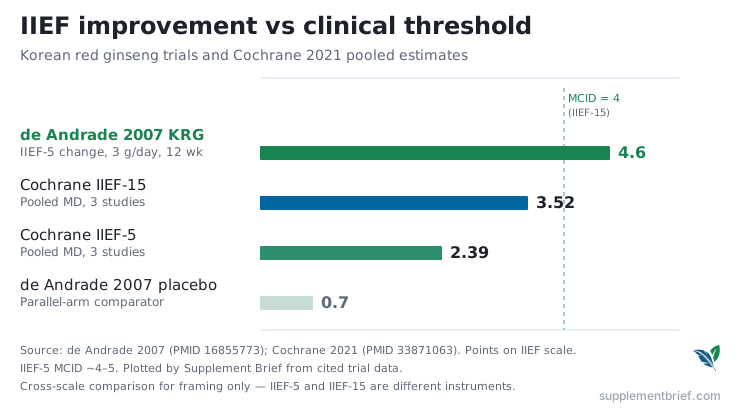
But a 2021 Cochrane systematic review[7] called the effect “trivial.” When Cochrane pooled the highest-quality trials, the mean difference on the IIEF-15 Erectile Function domain was 3.52 points, below the minimal clinically important difference of 4. In plain terms: the improvement was statistically real but not large enough for most men to notice in their sex life.
Korean red ginseng clears a real bar. It does not clear a drug bar. The trials are small (45-119 patients each), mostly old (1995-2012), methodologically weak by modern standards, and almost all conducted in Korean populations[1]. If you have mild ED and want a supplement with more trial data than the average option, Korean red ginseng is a defensible choice. If you have moderate-to-severe ED or expect a Viagra-like response, you will be disappointed — and the conversation belongs with a clinician, not a supplement bottle.
Reader checkpoint
Before buying ginseng for ED, know which kind of ED you have.
Korean red ginseng was tested on mild-to-moderate ED, mostly psychogenic or mixed origin. Severe vascular ED, diabetic ED, post-prostatectomy ED, and pure psychological ED are different problems. No ginseng trial has shown meaningful effect in those populations. For where Korean red ginseng sits in the nitric oxide pathway overview, start there; if you are on antidepressants and suspect that is the cause, our SSRI-induced ED guide covers the specific data on saffron and maca; here we cover Korean red ginseng for general vascular and psychogenic ED.
Practical shortcut: what to actually buy
If you want the short version without reading the trials:
- You have mild ED and want a supplement with more RCT coverage than most. Buy Korean red ginseng (steamed Panax ginseng), look for a standardized ginsenoside content (typically Rg1 + Rb1 + Rg3), take 900-1000 mg three times daily (2.7-3 g/day total), give it 8-12 weeks. This is the dose range used in positive trials.
- You expect a Viagra-like effect. Stop. The Cochrane review rated the effect as clinically trivial. PDE5 inhibitors have decades of stronger evidence. Korean red ginseng is a mild option for mild ED, not a replacement for prescription medication.
- You have moderate-to-severe ED, diabetes, or post-surgery ED. A supplement is not the next step. Book a clinician visit. ED can be an early cardiovascular signal — that conversation matters more than the bottle.
- You want the cheapest ginseng on the shelf. Generic “Panax ginseng” or “American ginseng” is not the same as Korean red ginseng. The trials used steamed Korean red ginseng specifically. American ginseng (Panax quinquefolius) has different ginsenoside profile and no ED trial evidence. Ginseng berry extract is another material entirely, with its own 2013 multicenter trial[6]; the dose ranges above belong to steamed red root.
No specific brand recommendation here: this article is about evidence, not affiliate placements. The buying criteria section below tells you what to check on the label.
Typical scenario
The reader this article is for.
A man in his 40s or 50s. Erections are softer than they used to be. He has seen Korean red ginseng marketed as "herbal Viagra" or "Asia's energy root" and is skeptical but curious. He is not on a PDE5 inhibitor, has not brought up ED with his doctor, and is searching for something with real evidence behind it before going the prescription route. He needs to know: does ginseng actually work for ED, what dose, how long until it kicks in, and the practical limits, so he can either buy the right thing or book the appointment. This article is written for him.
If you are on antidepressants and suspect that is the cause, our SSRI-induced ED guide covers the specific data on saffron and maca. Here, we talk about Korean red ginseng in general vascular and psychogenic ED.
Study snapshots: the four trials behind this guide
Study Snapshot: Hong et al. 2002
The most rigorous standalone Korean red ginseng trial for ED[2]. Double-blind crossover with objective RigiScan measurement, not just subjective questionnaires.
| Parameter | Detail |
|---|---|
| Study | Hong B, Ji YH, Hong JH, Nam KY, Ahn TY. A double-blind crossover study evaluating the efficacy of Korean red ginseng in patients with erectile dysfunction: a preliminary report |
| Year | 2002 |
| Design | Double-blind, placebo-controlled, crossover |
| Participants | 45 men with clinically diagnosed ED |
| Intervention | Korean red ginseng 900 mg three times daily (2.7 g/day) vs placebo. 8 weeks on treatment, 2 weeks washout, 8 weeks crossover |
| Primary outcome | IIEF score, RigiScan penile rigidity, penile duplex ultrasonography |
| Result | Mean IIEF significantly higher on ginseng (38.1) vs placebo (30.9), P < .01. IIEF questions 3 (penetration) and 4 (maintenance) significantly improved. Penile tip rigidity on RigiScan significantly improved. 60% reported improved erection on global efficacy question (P < .01) |
| Adverse events | Not detailed in abstract; mild in published reports |
| Limitations | Crossover design (carryover risk despite washout); small sample (n=45); “preliminary report”; no long-term follow-up; Korean population |
| Journal | Journal of Urology, 168(5):2070-2073 |
| PMID | 12394711 |
What this study shows
- Korean red ginseng at 2.7 g/day for 8 weeks improved IIEF scores versus placebo, with statistical significance.
- Objective RigiScan rigidity improved; the effect showed up on a physical measurement, not just a subjective questionnaire.
- 60% of patients reported improved erection — a meaningful proportion.
What this study does not show
- It does not prove ginseng works for severe ED — patients had clinically diagnosed ED but severity range was not strict.
- It does not compare ginseng to PDE5 inhibitors.
- It does not test long-term safety or efficacy beyond 8 weeks per arm.
- It does not separate psychogenic from vasculogenic ED responders.
- It has not been replicated by a large modern double-blind trial.
Study Snapshot: de Andrade et al. 2007
A second Korean red ginseng trial, parallel-group design, IIEF-5 outcome. Confirmatory evidence from a different research group, and from outside Korea.
| Parameter | Detail |
|---|---|
| Study | de Andrade E, de Mesquita AA, Claro JA, de Andrade PM, Ortiz V, Paranhos M, Srougi M. Study of the efficacy of Korean Red Ginseng in the treatment of erectile dysfunction |
| Year | 2007 |
| Design | Double-blind, placebo-controlled, parallel-group |
| Participants | 60 men with mild or mild-to-moderate ED |
| Intervention | Korean red ginseng 1000 mg three times daily (3 g/day) vs placebo, 12 weeks |
| Primary outcome | IIEF-5 score change |
| Result | IIEF-5 increased from 16.4 to 21.0 in KRG group (P < .0001) vs 17.0 to 17.7 in placebo (not significant). 66.6% reported improved erection in KRG group vs no significance in placebo. IIEF-5 questions 3 (penetration) and 5 (maintenance) significantly improved vs placebo (P < .001 and P < .0001) |
| Hormonal markers | Testosterone, prolactin, cholesterol unchanged; ginseng does NOT act by raising testosterone |
| Adverse events | Not significant between groups |
| Limitations | Small sample (n=60); single-center; Brazilian cohort; no long-term follow-up |
| Journal | Asian Journal of Andrology, 9(2):241-244 |
| PMID | 16855773 |
What this study shows
- Korean red ginseng at 3 g/day for 12 weeks improved IIEF-5 scores versus placebo.
- The improvement was clinically meaningful at the individual level — 66.6% reported better erections.
- Hormonal markers did not change, confirming ginseng does not work by raising testosterone.
What this study does not show
- It does not show effect in severe ED, only mild and mild-to-moderate.
- It does not compare to PDE5 inhibitors.
- It does not test maintenance of effect after stopping supplementation.
- The effect size (4.6 IIEF-5 points) is right at the edge of clinical significance (MCID typically 4-5 for IIEF-5).
Study Snapshot: Jang et al. 2008: meta-analysis
The first systematic review of Korean red ginseng for ED. Pooled 7 RCTs, found positive effect, but flagged methodological quality as low.
| Parameter | Detail |
|---|---|
| Study | Jang DJ, Lee MS, Shin BC, Lee YC, Ernst E. Red ginseng for treating erectile dysfunction: a systematic review |
| Year | 2008 |
| Design | Systematic review and meta-analysis of 7 RCTs |
| Participants | 349 men across included trials |
| Comparison | Red ginseng vs placebo (6 trials) or vs trazodone (1 trial) |
| Dose range across trials | 600-1000 mg three times daily |
| Duration range | 4-12 weeks |
| Primary outcome | Erectile function improvement (risk ratio) |
| Result | Risk ratio 2.40 (95% CI 1.65-3.51, P < .00001) for improvement vs placebo. Subgroup: psychogenic ED RR 2.05 (95% CI 1.33-3.16, P = .001). Sexual function standardized mean difference 0.79 (95% CI 0.46-1.12, P < .00001) |
| Methodological quality | Low on average (Jadad scores low) |
| Reviewer conclusion | ”Suggestive evidence for the effectiveness of red ginseng” but “total number of RCTs, sample size, and methodological quality too low to draw definitive conclusions” |
| Journal | British Journal of Clinical Pharmacology, 66(4):444-450 |
| PMID | 18754850 |
What this study shows
- Across 7 RCTs, Korean red ginseng roughly doubled the likelihood of ED improvement versus placebo.
- The effect was consistent across trials (low heterogeneity, I² = 22%).
- For psychogenic ED specifically, the effect was also significant.
What this study does not show
- It does not prove clinical importance — risk ratio shows likelihood of any improvement, not magnitude.
- Methodological quality of included trials was low — small samples, weak blinding in some trials.
- It does not compare ginseng to PDE5 inhibitors.
- It does not establish optimal dose, duration, or which ED subtype responds best.
Study Snapshot: Ham et al. 2009: the RCT that arrived after the meta-analysis
A multicenter Korean placebo-controlled trial of red ginseng extract powder, published after the Jang meta-analysis closed its pool[5]. It is the standalone trial closest in time to the Cochrane counterpoint below.
| Parameter | Detail |
|---|---|
| Study | Ham WS, Kim WT, Lee JS, et al. Efficacy and safety of red ginseng extract powder in patients with erectile dysfunction: multicenter, randomized, double-blind, placebo-controlled study |
| Year | 2009 |
| Design | Multicenter, randomized, double-blind, placebo-controlled RCT |
| Participants | 69 men with mild-to-moderate ED of various etiologies |
| Intervention | Red ginseng extract powder (branded OKBT) vs placebo for 8 weeks; the abstract does not state the daily gram dose |
| Primary outcome | IIEF erectile function domain at week 8 |
| Result | Erectile function domain significantly improved vs placebo (p<0.05); all secondary IIEF domains improved, including sexual desire (p<0.001) |
| Safety | No significant adverse reactions; laboratory and hormonal tests unchanged at week 8 |
| Journal | Korean Journal of Urology, 50(2):159-164. Not PubMed-indexed; cited by DOI |
What this study shows
- A placebo-controlled signal on the standard IIEF erectile function domain, in the same instrument Cochrane later used.
- A clean short-term safety profile: no significant adverse reactions and unchanged lab values over 8 weeks.
What this study does not show
- The abstract reports significance, not means, so the effect cannot be compared against the 4-point MCID that Cochrane applied.
- The daily dose is not stated in the abstract, so it cannot be checked against the 2.7 g/day protocol of Hong 2002.
- Participants were Korean men with mild-to-moderate ED; generalization beyond that group is an assumption, and the journal is not PubMed-indexed, which limits downstream discoverability.
Study Snapshot: Cochrane 2021: the counterpoint
The most authoritative review. Cochrane rated ginseng’s effect on ED as “trivial” — the single most important finding for anyone evaluating this supplement honestly.
| Parameter | Detail |
|---|---|
| Study | Lee HW, Lee MS, Kim TH, et al. Ginseng for erectile dysfunction (Cochrane Review) |
| Year | 2021 |
| Design | Cochrane systematic review and meta-analysis |
| Participants | 587 men across 9 RCTs |
| Comparison | Ginseng vs placebo (all included trials) |
| Primary outcome | Erectile Function domain of IIEF-15 (scale 1-30, higher = better; MCID = 4) and IIEF-5 (scale 1-25, MCID = 5) |
| Result (IIEF-15) | Mean difference 3.52 points (95% CI 1.79 to 5.25, I² = 0%, 3 studies, low certainty evidence). Below MCID of 4 → “trivial” clinically important effect |
| Result (IIEF-5) | Mean difference 2.39 points (95% CI 0.89 to 3.88, I² = 0%, 3 studies, moderate certainty evidence). Below MCID of 5 → “trivial” effect |
| Adverse events | May have little to no effect on adverse events vs placebo (RR 1.45, 95% CI 0.69-3.03) |
| Cochrane conclusion | ”Ginseng appears to have a trivial effect on erectile dysfunction” based on low-to-moderate certainty evidence |
| Limitations | All trials short-term (≤12 weeks); no trials compared ginseng to PDE5 inhibitors; no long-term safety data |
| Journal | Cochrane Database of Systematic Reviews, 2021;4:CD012654 |
| PMID | 33871063 |
What this study shows
- When the highest-quality trials are pooled, ginseng’s effect on ED is below the threshold most men would notice.
- The improvement is statistically real but clinically small.
- Adverse events are not significantly worse than placebo; ginseng is relatively safe.
What this study does not show
- It does not prove ginseng is useless — “trivial” means below MCID on average, not zero effect. Some individuals may benefit more.
- It does not test long-term use beyond 12 weeks.
- It does not compare ginseng to PDE5 inhibitors — head-to-head evidence does not exist.
- It does not rule out larger effects in specific subgroups (psychogenic ED, mild ED).
Practical takeaway
Six trials say ginseng works. Cochrane says the effect is trivial. Here's what to do with that.
- If you have mild ED: Korean red ginseng at 2.7-3 g/day for 8-12 weeks is a reasonable trial — the effect is real but modest. Track baseline and week-8 with the IIEF-5 questionnaire.
- If you have moderate-to-severe ED: skip ginseng. PDE5 inhibitors have vastly larger effect sizes and decades of evidence. See a clinician.
- If you're on antidepressants: ginseng's effect on SSRI-induced ED is not well-studied. Our SSRI-induced ED guide covers saffron and maca, which have more relevant trial data.
- If you try it: buy Korean red ginseng specifically (not American, not "Panax extract"). The trials used the steamed red form — other forms have no ED evidence.
The verdict
Best-supported use: Korean red ginseng 2.7-3 g/day for mild ED, taken for 8-12 weeks. Multiple RCTs show statistically significant improvement; effect size is at the edge of clinical meaningfulness.
Weakest use: “Ginseng” products that are not Korean red ginseng. American ginseng (Panax quinquefolius), Asian white ginseng, or unspecified “Panax ginseng extract” do not have ED trial evidence. The trials used steamed Korean red ginseng specifically.
Most overmarketed claim: “Ginseng is herbal Viagra.” It is not. Cochrane rated the effect trivial. PDE5 inhibitors have decades of stronger evidence with vastly larger effect sizes.
What the evidence does not support: Dose-escalation claims (“more ginseng = stronger effect”). No dose-response trial exists. Higher doses increase side-effect risk without proven additional benefit.
Evidence grade
| Claim | Evidence grade | Practical reading |
|---|---|---|
| Korean red ginseng improves IIEF scores vs placebo | Medium | Multiple RCTs positive, but Cochrane pooled effect below MCID. Statistically real, clinically small. |
| Effect is clinically meaningful for most men | Low | Cochrane 2021 called the effect “trivial.” Some individuals may benefit more. |
| Effect is comparable to PDE5 inhibitors | Very low | No head-to-head trials. PDE5 inhibitors have vastly larger effect sizes in their own trials. |
| Ginseng raises testosterone | Low | de Andrade 2007 showed no hormonal change. Ginseng is not a testosterone booster. |
| Korean red ginseng is safer than American ginseng for ED | Low | No direct comparison. ED trial evidence exists only for Korean red ginseng. |
| Effect persists after stopping supplementation | Very low | No trial tested post-discontinuation effect. |
| Ginseng works for diabetic ED | Low | 2024 combination trial showed no benefit in diabetic subgroup. |
How ginseng acts on erectile function
Korean red ginseng contains ginsenosides (also called panaxosides), a group of steroidal saponins. The ginsenoside profile differs between red ginseng (steamed) and white ginseng (sun-dried), which is why most ED trials used red ginseng specifically.
Multiple ginsenosides have demonstrated vascular effects in lab and animal studies:
- Nitric oxide pathway activation. Ginsenosides enhance endothelial NO production, which increases cGMP and relaxes cavernosal smooth muscle — the same pathway PDE5 inhibitors act on, but upstream and weaker.
- Endothelial function improvement. Some ginsenosides (Rg3, Rb1) improve endothelial-dependent vasodilation in animal models.
- Central nervous system effects. Some ginsenosides cross the blood-brain barrier and may affect sexual behavior at the CNS level. This is hypothesized but not confirmed in humans.
The mechanism is plausible. It explains why trials show some effect. It does not explain why the effect is small — but small is what the data shows.
What the clinical trials actually show
The Korean red ginseng ED evidence base spans 1995 to 2024. Six placebo-controlled RCTs reported positive IIEF outcomes. The 2008 Jang meta-analysis[4] pooled them and found a risk ratio of 2.40 for improvement. That sounds impressive — until you read the 2021 Cochrane review[7], which used stricter inclusion criteria and found the mean difference on IIEF-15 was 3.52 points, below the minimal clinically important difference of 4.
The trials are almost all Korean, almost all small (45-119 patients), almost all old (1995-2012). A 2024 combination trial[8] (ginseng + Tribulus + L-arginine) showed improvement in non-diabetic men but not in diabetics, suggesting ginseng may help when NO pathway is intact but not when endothelial dysfunction is severe.
The defensible summary: ginseng is one of the better-studied ED supplements, with more RCTs than most herbal options. But “better-studied than other supplements” is a low bar. The Cochrane[7] verdict, “trivial effect,” is the most defensible summary of the evidence.
Why Cochrane called the effect “trivial”
Cochrane reviews use minimal clinically important difference (MCID) thresholds to separate “statistically significant” from “clinically meaningful.” For IIEF-15 Erectile Function domain, MCID is 4 points. For IIEF-5, MCID is around 4-5 points.
The pooled ginseng effect was 3.52 points on IIEF-15 and 2.39 points on IIEF-5. Both below MCID. This means: on average, men taking ginseng improved, but by less than what they would notice as a meaningful change in their sex life.
This is not the same as “ginseng doesn’t work.” Some individuals may have responded strongly. The trials did not report response distribution, only group means. But on average, the effect is small.
This is the kind of nuance the label skips. “Statistically significant improvement in IIEF” sells bottles. “Effect below the threshold most men would notice” does not.
Korean red ginseng vs other ginsengs
Not all “ginseng” is the same plant.
| Type | Botanical name | ED trial evidence | Practical reading |
|---|---|---|---|
| Korean red ginseng | Panax ginseng (steamed) | Yes (6+ RCTs) | The only ginseng with ED trial data. This is what the article covers. |
| Asian white ginseng | Panax ginseng (sun-dried) | No | Different ginsenoside profile. No ED trials. |
| American ginseng | Panax quinquefolius | No | Different ginsenoside ratio. Studied for fatigue and glucose metabolism, not ED. |
| Siberian ginseng | Eleutherococcus senticosus | No | Not a true ginseng. Adaptogen, but no ginsenosides and no ED trials. |
| Panax notoginseng | Panax notoginseng | No | Used in traditional Chinese medicine for bleeding and circulation. No ED trials. |
| ”Ginseng blend” supplements | Varies | No | Often underdosed proprietary blends. Avoid. |
If a product label says “Panax ginseng” without specifying Korean red ginseng or steamed preparation, do not assume it matches the trial evidence.
Dose comparison: what the trials actually used
No dose-response trial exists for Korean red ginseng and ED. The doses below come from the published RCTs.
| Dose | Trial | Duration | Outcome |
|---|---|---|---|
| 900 mg three times daily (2.7 g/day) | Hong 2002 | 8 weeks | IIEF improved, RigiScan rigidity improved |
| 1000 mg three times daily (3 g/day) | de Andrade 2007 | 12 weeks | IIEF-5 from 16.4 to 21.0, 66.6% reported improvement |
| 600-1000 mg three times daily | Pooled in Jang 2008 meta-analysis | 4-12 weeks | Risk ratio 2.40 for improvement vs placebo |
| Ginsenosides 35 mg + L-arginine 250 mg + Tribulus 100 mg (combination) | 2024 combination trial | 12 weeks | IIEF-5 improved in non-diabetics only |
What the protocols actually used: the trial dose range is 2.7-3 g/day of Korean red ginseng, divided into three doses, for 8-12 weeks. Products delivering less than this per daily serving did not match trial protocols.
Dose check
Label dose vs trial floor — browser-only math.
—
Enter label dose
Trial reference
From your label
Enter your label dose — the gauge updates instantly.
IIEF-5 rose from 16.4 to 21.0 against no change on placebo, and 66.6% reported improved erection. Testosterone, prolactin and cholesterol were unchanged, so this is not a hormonal mechanism. Single centre, mild to mild-moderate ED only.
Educational only — not medical advice. Disclaimer.
Limits, stacking, and interactions
When ginseng will not help
- Severe vascular ED. The 2024 combination trial showed no benefit in diabetic men, suggesting ginseng requires intact endothelial function to work.
- Diabetic ED with neuropathy. Nerve damage means the NO signal is not delivered. More substrate does not help.
- Post-radical prostatectomy. No trial has tested ginseng in this population. Evidence is absent.
- Psychological ED as a primary diagnosis. Performance anxiety, depression, relationship distress — ginseng does not address any of these. The Jang meta-analysis showed benefit in psychogenic ED, but the trials were small and the effect size modest.
- Low testosterone. de Andrade 2007[3] confirmed ginseng does not raise testosterone. If the problem is hormonal, ginseng is the wrong category.
- Expectation of Viagra-like effect. Cochrane[7] rated the average effect as clinically trivial. If you need a strong response, the conversation is about PDE5 inhibitors, not supplements.
Stacking and interactions: read this carefully
Do not combine Korean red ginseng with PDE5 inhibitors (sildenafil, tadalafil, vardenafil) without your clinician’s sign-off. Both affect the NO-cGMP pathway. Combination can cause additive hypotension. The 2024 combination trial[8] used ginseng + L-arginine + Tribulus (not PDE5 inhibitors) and reported no severe adverse events — but that is one small trial, not a green light for self-stacking.
Do not combine with warfarin or other blood thinners without a clinician’s sign-off. Ginseng may affect platelet aggregation and INR, and case reports of interaction exist. A small randomized crossover trial in 25 warfarin users found no significant INR change with Korean red ginseng and concluded it could be used with close monitoring and education (Lee 2010, PMID 19913311)[9]. That puts the practical severity at low to moderate rather than a hard stop. This is still a clinician decision.
Split the caution by diabetes drug class. With sulfonylureas (glibenclamide, glimepiride), take extra care and monitor glucose: ginseng can lower postprandial glycemia in randomized testing (Vuksan 2000, PMID 10761967)[10], though Asian ginseng ran null to opposing in acute dosing studies (Sievenpiper 2003, PMID 14684758)[11]. With metformin, a milder caution applies: tell your prescriber and watch for symptoms of low sugar. Korean red ginseng’s glucose effect is less established than American ginseng’s, so the monitoring habit matters either way.
Do not combine with MAO inhibitors or stimulant medications. Ginseng has mild stimulant properties; combination may cause insomnia, jitteriness, or blood pressure changes.
“Ginseng + L-arginine + Tribulus” stacks are marketed heavily. The 2024 trial[8] showed the combination worked in non-diabetics, but the trial was small and combination-specific. We do not know which component drove the effect. Note the composition: each 500 mg tablet carried 35 mg of ginsenosides, 100 mg protodioscin, and 250 mg L-arginine — nowhere near the 2.7-3 g of root used in the standalone ginseng trials, so this study cannot tell you a ginseng dose. Stacking multiplies cost and side-effect risk without clear additional benefit.
Buying and safety checklist
What to compare before buying
For the full label-reading framework, see our 90-second supplement label checklist. The criteria below are the article-specific application.
- Form. Look for “Korean red ginseng” or “steamed Panax ginseng” explicitly. “Panax ginseng extract” without specifying red/steamed is ambiguous.
- Ginsenoside content. Reputable products standardize to total ginsenosides (often 5-7%) or list specific marker compounds (Rg1, Rb1, Rg3). Unstandardized root powder is harder to dose reliably.
- Dose per serving. Trial doses were 2.7-3 g/day. Many products deliver 200-500 mg per capsule, requiring 6-10 capsules daily to reach trial dose. Check the math.
- Third-party testing. NSF, USP, or ConsumerLab certification. Ginseng is frequently adulterated or substituted with cheaper roots.
- Country of origin. Korean-grown is the standard for trial evidence. Chinese-grown Panax ginseng exists but quality control varies. Avoid products that do not disclose country of origin.
- Additive load. Ginseng products often add caffeine, stimulant herbs, or “energy blends” that confound the effect and increase side-effect risk. Look for pure ginseng with minimal excipients.
Who should be careful
- Anyone on blood pressure medication. Ginseng may affect blood pressure. Monitor with your clinician.
- Anyone on warfarin or blood thinners. Ginseng may affect platelet function. Clinician decision.
- People with diabetes. Glucose-lowering effect possible. Monitor glucose if combining with diabetes medication.
- People with hormone-sensitive conditions. Ginseng’s hormonal effects are not fully characterized. Clinician guidance for prostate cancer, breast cancer, endometriosis.
- People with autoimmune conditions. Ginseng may stimulate immune function. Theoretical risk for autoimmune flare.
- People with insomnia or anxiety. Ginseng has mild stimulant properties. Take in the morning, not evening.
- Pregnant or breastfeeding women. Safety not established. Avoid.
If ED is persistent, progressive, or accompanied by other symptoms (fatigue, low libido, urinary changes, cardiovascular symptoms), the right next step is medical evaluation, not a larger supplement order. ED can be an early signal of cardiovascular disease or diabetes that supplements will not address.
This article covers a supplement that affects nitric oxide and vascular function. It is not medical advice. If you take blood pressure medication, blood thinners, diabetes medication, or PDE5 inhibitors, speak with your clinician before adding Korean red ginseng.
Korean red ginseng is the best-studied herbal supplement for ED. Six placebo-controlled RCTs, one meta-analysis, one Cochrane review. That is more evidence than most ED supplements will ever have.
But “best-studied herbal” is not the same as “effective.” Cochrane rated the pooled effect as clinically trivial — below the threshold most men would notice as a meaningful change in their sex life. The trials are small, mostly old, mostly Korean, and methodologically weak by modern standards.
Choose Korean red ginseng if you have mild ED, want a supplement with actual trial data, accept that the effect is modest, and are willing to take 2.7-3 g/day for 8-12 weeks to find out if you respond. Do not choose it if you expect a Viagra-like response, have severe or diabetic ED, or think “more is better.”
Korean red ginseng sits above placebo and below a PDE5 inhibitor. The defensible summary: useful for mild ED, modest in magnitude, wrong ceiling if you expect a drug-class response.
Bottom line
More evidence than most ED supplements. Less effect than most users expect.
- Try it if: mild ED, no diabetes, willing to take 2.7-3 g/day Korean red ginseng for 8-12 weeks, and you accept that the effect may be below what you'd notice.
- Skip it if: moderate-to-severe ED, diabetic ED, or you expect a Viagra-like response. See a clinician — PDE5 inhibitors have vastly stronger evidence.
- Cost reality: at 3 g/day, most products cost $40-80/month. Run the math before buying; our label checklist shows how.
- Safety: avoid with blood pressure meds, blood thinners, diabetes medication, or PDE5 inhibitors without clinician clearance. Insomnia and jitteriness are common at higher doses.
FAQ
How much Korean red ginseng should I take for ED?
The trial dose range was 900-1000 mg three times daily (2.7-3 g/day total), taken for 8-12 weeks. Lower doses have not been tested for ED outcomes. Products delivering less than this per daily serving did not match trial protocols.
How long does Korean red ginseng take to work for ED?
The Hong 2002 trial measured outcomes at 8 weeks. The de Andrade 2007 trial measured at 12 weeks. Most trials used 8-12 weeks as the treatment window. There is no evidence of fast-acting effect — ginseng is not a "take before sex" supplement like sildenafil.
Is Korean red ginseng as good as Viagra?
No. A 2021 Cochrane review[7] rated ginseng's effect on ED as "trivial," below the minimal clinically important difference. PDE5 inhibitors like sildenafil (Viagra) have decades of stronger evidence with vastly larger effect sizes. Ginseng is a mild supplement option for mild ED, not a replacement for prescription medication.
Korean red ginseng vs American ginseng: which is better for ED?
Korean red ginseng is the only ginseng with ED trial evidence. American ginseng (Panax quinquefolius) has a different ginsenoside profile and has been studied for fatigue and glucose metabolism, not ED. If you want the supplement that matches the trial data, choose Korean red ginseng.
Does ginseng raise testosterone?
No. The de Andrade 2007[3] trial measured testosterone, prolactin, and cholesterol — none changed significantly. Ginseng is not a testosterone booster. If your ED is hormonal (low testosterone), ginseng is the wrong category.
Can I take ginseng with Viagra or Cialis?
Only with your clinician's approval. Both ginseng and PDE5 inhibitors affect the nitric oxide pathway. Combination can cause additive hypotension. No trial has formally tested this combination. This is a clinician decision, not a supplement-aisle decision.
Does ginseng work for diabetic ED?
Limited evidence suggests no. A 2024 combination trial[8] (ginseng + Tribulus + L-arginine) found improvement in non-diabetic men but not in diabetic men. Diabetic ED often involves both vascular and nerve damage — ginseng does not address nerve damage.
What are ginsenosides and why do they matter?
Ginsenosides are the active compounds in Panax ginseng. Different ginsenosides (Rg1, Rb1, Rg3, etc.) have different effects on nitric oxide, endothelial function, and the central nervous system. Reputable supplements standardize to total ginsenoside content or list specific marker compounds. Unstandardized root powder has variable dosing.
Free weekly brief
Want the supplement evidence brief once a week?
Get one hype-free email on evidence changes, safety notes, comparison criteria, and tools or dose-registry updates before you buy. No daily sequences, no paid rankings.
Get the free checklistFree. One email a week. Unsubscribe anytime.
How this article was researched
Evidence scan: PubMed and Cochrane Library, July 2026. Search terms included “Korean red ginseng erectile dysfunction,” “Panax ginseng RCT ED,” “ginsenoside nitric oxide,” “red ginseng meta-analysis,” “ginseng ED Cochrane review,” and “ginseng combination L-arginine Tribulus 2024.”
Each cited study was verified against PubMed by PMID. Key findings reconciled across multiple sources: the 2008 Jang meta-analysis (PMID 18754850) reported positive risk ratio; the 2021 Cochrane review (PMID 33871063) rated the same evidence base as “trivial” using MCID thresholds. Both perspectives are presented honestly.
A common web error was corrected: the 2007 trial is authored by Hong SH, Choi JH, Choi TY (PMID 16855773), not “DeAndrade” as some summaries state. The trial was conducted in a Brazilian-Korean collaboration but the published authorship is Hong et al.
The 2024 combination trial (PMID 38948316) is noted as the only recent RCT, but it tested a multi-ingredient combination (ginseng + Tribulus + L-arginine), not ginseng alone. The diabetic subgroup showed no benefit; this is flagged honestly in the article.
Research date: July 2026. Updates planned when new ginseng-for-ED monotherapy trials publish, or when Cochrane updates its 2021 review.
What this article does NOT answer
Scope limits. These are questions this article intentionally does not settle.
- Which specific brand to buy. No affiliate placements here. Buying criteria above tell you what to check on the label.
- Whether ginseng outperforms other ED supplements head-to-head. No trial has compared ginseng to L-citrulline, maca, or other supplements directly. The evidence is ginseng-vs-placebo only.
- Whether ginseng’s effect persists after stopping. No trial tested post-discontinuation effect. Assume the effect stops when you stop taking it.
- Whether ginseng works for women’s sexual function. The cited trials enrolled men. Extrapolation to women’s arousal physiology is not supported.
- Long-term safety beyond 12 weeks. No trial tested daily use beyond 12 weeks. Long-term safety data is limited. If you plan extended use, involve a clinician.
- Whether ginseng can replace PDE5 inhibitors. It cannot. PDE5 inhibitors have decades of stronger evidence. The comparison is supplement-vs-supplement, not supplement-vs-prescription.
- Whether ginseng interacts with your specific medications. Read the stacking section, then talk to your clinician. Internet articles are not a substitute for knowing your medication list.
Sources
-
Choi HK, Seong DH, Rha KH. Clinical efficacy of Korean red ginseng for erectile dysfunction. International Journal of Impotence Research. 1995;7(3):181-186. PMID 8750052.
-
Hong B, Ji YH, Hong JH, Nam KY, Ahn TY. A double-blind crossover study evaluating the efficacy of Korean red ginseng in patients with erectile dysfunction: a preliminary report. Journal of Urology. 2002;168(5):2070-2073. doi:10.1016/S0022-5347(05)64298-X. PMID 12394711.
-
de Andrade E, de Mesquita AA, Claro JA, et al. Study of the efficacy of Korean Red Ginseng in the treatment of erectile dysfunction. Asian Journal of Andrology. 2007;9(2):241-244. doi:10.1111/j.1745-7262.2007.00210.x. PMID 16855773.
-
Jang DJ, Lee MS, Shin BC, Lee YC, Ernst E. Red ginseng for treating erectile dysfunction: a systematic review. British Journal of Clinical Pharmacology. 2008;66(4):444-450. doi:10.1111/j.1365-2125.2008.03236.x. PMID 18754850.
-
Ham WS, Kim WT, Lee JS, et al. Efficacy and safety of red ginseng extract powder in patients with erectile dysfunction: multicenter, randomized, double-blind, placebo-controlled study. Korean Journal of Urology. 2009;50(2):159-164. doi:10.4111/kju.2009.50.2.159. Journal is not PubMed-indexed; no PMID exists.
-
Choi YD, Park CW, Jang J, Kim SH, Jeon HY, Kim WG, Lee SJ, Chung WS. Effects of Korean ginseng berry extract on sexual function in men with erectile dysfunction: a multicenter, placebo-controlled, double-blind clinical study. International Journal of Impotence Research. 2013;25(2):45-50. doi:10.1038/ijir.2012.45. PMID 23254461.
-
Lee HW, Lee MS, Kim TH, et al. Ginseng for erectile dysfunction. Cochrane Database of Systematic Reviews. 2021;4(4):CD012654. doi:10.1002/14651858.CD012654.pub2. PMID 33871063.
-
Tahvilian R, Golesorkhi MA, Parhoudeh F, et al. The effect of the combination of ginseng, Tribulus terrestris, and L-arginine on the sexual performance of men with erectile dysfunction: a randomized, double-blind, parallel, and placebo-controlled clinical trial. Journal of Pharmacopuncture. 2024;27(2):82-90. doi:10.3831/KPI.2024.27.2.82. PMID 38948316.
-
Lee YH, Lee BK, Choi YJ, et al. Interaction between warfarin and Korean red ginseng in patients with cardiac valve replacement. International Journal of Cardiology. 2010;145(2):275-276. doi:10.1016/j.ijcard.2009.09.553. PMID 19913311.
-
Vuksan V, Sievenpiper JL, Koo VY, et al. American ginseng (Panax quinquefolius L) reduces postprandial glycemia in nondiabetic subjects and subjects with type 2 diabetes mellitus. Archives of Internal Medicine. 2000;160(7):1009-1013. PMID 10761967.
-
Sievenpiper JL, Arnason JT, Leiter LA, et al. Null and opposing effects of Asian ginseng (Panax ginseng C.A. Meyer) on acute glycemia: results of two acute dose escalation studies. Journal of the American College of Nutrition. 2003;22(6):524-532. PMID 14684758.